the dry·docks
/ðə ˈdraɪ ˌdɑks/ – noun
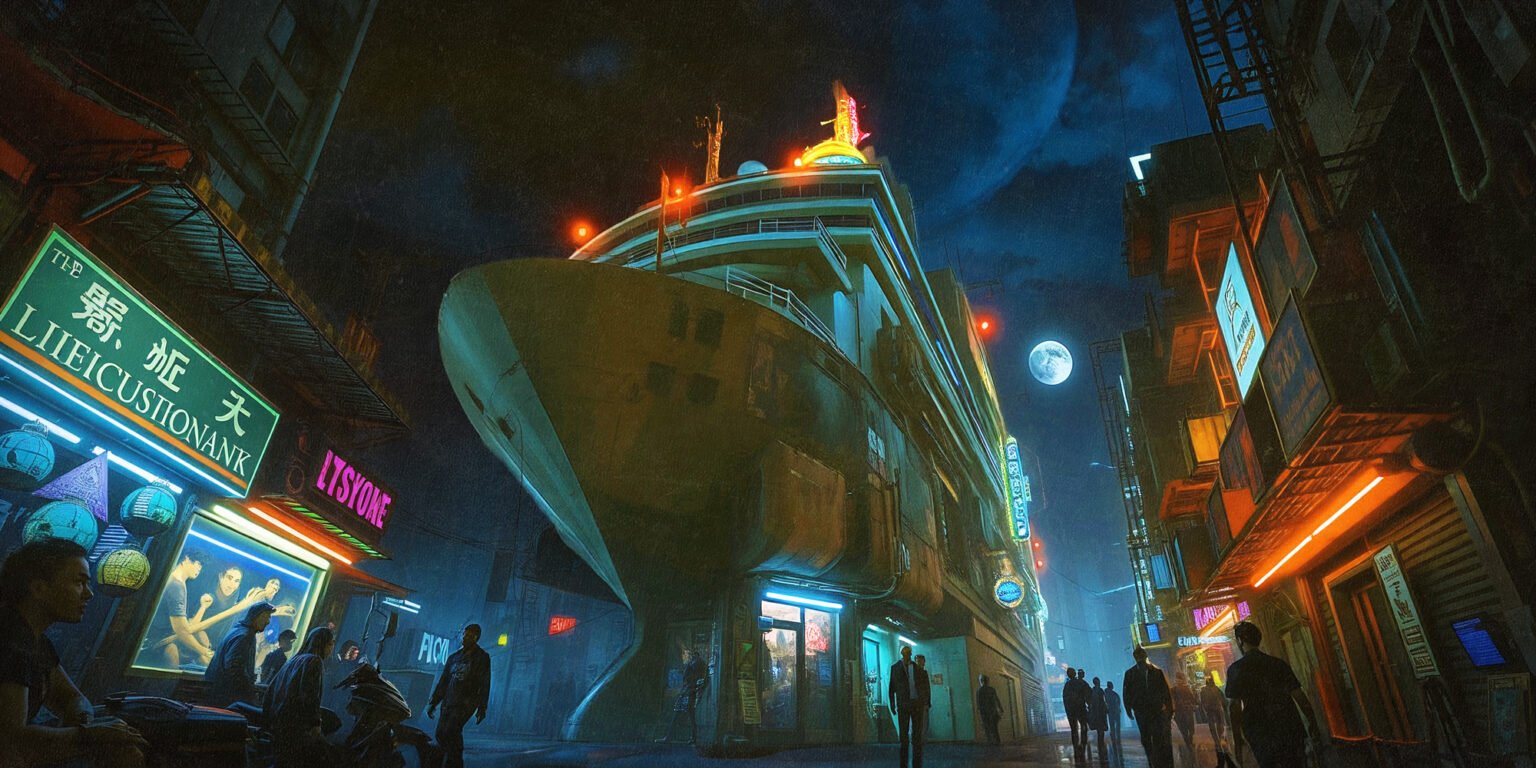
Massive repurposed cruise ships and cargo vessels transformed into apartment complexes and communities after the maritime industry’s catastrophic collapse, creating a new urban landscape that spans from ultra-luxury waterfront estates to the most dangerous criminal slums on Earth.
These floating cities represent humanity’s desperate adaptation to a world where tethering technology made ocean travel obsolete overnight, leaving entire industries to either innovate or die.
THE COLLAPSE THAT CHANGED EVERYTHING
When tethering burst onto the scene, it didn’t just revolutionize travel—it obliterated entire industries in a matter of months. The ability to transport goods, people, and even entire souls across vast distances through digital networks made physical ocean transport obsolete overnight.
“We went from booking million-dollar cruises to filing for bankruptcy in six weeks,” recalls former Oceanic Luxury Lines CEO Margaret Kali. “Our entire fleet—hundreds of vessels worth billions—became worthless metal floating in harbors worldwide.”
But from this economic apocalypse emerged something unprecedented: The Dry-Docks.
FROM VACATION TO DESPERATION
The most innovative of these doomed maritime corporations made a desperate but brilliant pivot…
Instead of scrapping their vessels, they dry-docked their massive ships on land and transformed passenger cabins into permanent living spaces. Former cruise directors became neighborhood coordinators HOA board members. Ship restaurants evolved into local dining establishments. The entertainment decks that once hosted vacation activities now serve as community centers for residents who may never leave their floating neighborhoods.
“Most people now just need enough space to rest their body, proper Etherverse connection, and access to food and baths,” explains urban sociologist Dr. Yuki Tanaka. “The ships already had everything—we just changed who was living there.”
THE SPECTRUM OF SURVIVAL
Today’s Dry-Docks exist across a terrifying spectrum of wealth and danger:
At the luxury end: The Helix – Luxury Waterfront Sky Villas attracts the planet’s wealthiest elite, featuring pristine amenities and prime locations that make traditional penthouses look primitive.
At the other extreme: Dense, crime-ridden floating slums where survival depends on participating in illegal activities. The phrase “in the dry-docks” has completely replaced the archaic and ancient phrase “in the ghetto” as society’s modern shorthand for poverty and desperation.
AETHERPOINT: THE ULTIMATE NIGHTMARE
The most notorious Dry-Dock settlement is AetherPoint—a sprawling maritime city floating south of Neo Manhattan that evolved from a massive floating prison colony. Built from interconnected megaships, ultra-large container vessels, and decommissioned cruise ships, AetherPoint has become the criminal capital of Earth.
“This city eats people alive… It’s literally the most dangerous place on earth and arguably in the entire universe,” warns former resident and reformed hacker known only as “Ghost.”
According to The CIA (Global Cyber Intelligence Agency), 85% of all Earth-originated cyber crimes in the Etherverse trace back to AetherPoint. The floating city operates under its own twisted governance system:
- Led by “The Warden” (the mayor equivalent)
- Citizens known as “Wards of AetherPoint”
- Self-policed through “The Street Code” rather than formal law enforcement
- Divided into sub-districts called The Seven Slums
- Features designated Safe Zones where families and children live under special protection
THE ECONOMY OF DESPERATION
AetherPoint thrives on a massive black market economy dealing in:
- Cryptocurrencies and stolen goods
- Proxy jacking operations
- Soul hacking services that steal and manipulate digital identities
“Gang affiliation gets passed down through generations here,” explains undercover investigator Sarah Nwigwe. “I’ve met criminals boasting six generations of family ties to the same gang. It’s not just crime—it’s inherited legacy.”
CULTURE OF THE CONDEMNED
Despite the danger, AetherPoint and other dry-dock communities pulse with vibrant underground culture. Electronic music mixes with evolved forms of ancient rap and hip-hop echo through ship corridors. Digital artists create graffiti that speaks to the rebellious spirit of residents who celebrate successful heists and technological breakthroughs as community holidays.
THE BROADER IMPLICATIONS
The Dry-Docks represent more than just housing—they’re a stark symbol of how technological advancement can simultaneously create opportunity and devastation. While wealthy individuals retreat to luxury dry-dock resorts with pristine amenities, the poor are warehoused in floating slums where survival depends on embracing criminality.
“We’re not just looking at alternative housing,” warns social economist Dr. Jim Jenkins. “We’re witnessing the creation of entirely new forms of social stratification. The Dry-Docks show us how quickly society can restructure around digital living and economic inequality.”
THE QUESTIONS THAT HAUNT
As The Dry-Docks continue to evolve, they raise disturbing questions about humanity’s future:
- What happens when entire industries die overnight?
- How do communities survive when their foundation disappears?
- Can innovation born from desperation ever truly escape its criminal origins?
- What does it mean to live in a world where your neighborhood (and hell-on-earth) was once someone’s vacation?
The Dry-Docks aren’t just housing—they’re humanity’s adaptation to a world that changed too fast, leaving entire populations to either innovate or die in the wake of technological revolution.