
There are worse tests than proving your humanity to a machine…
Although, usually they don’t involve sudden death…
The gravity tether releases you to a space — not to far away ahead of you is the entrance of a massive security gate, its surface rippling with digital encryption symbols. Binary sequences and hexadecimal strings ripple across walls and floors like living digital organisms, creating an environment that exists somewhere between physical and virtual.
A countdown timer hovering at “04:47” pulses in the corner of your vision, and beyond the gate, your waypoint marker glows with urgent insistence.
“Archivist?” you call out, your voice echoing in the void. “What exactly am I supposed to do here?”
You glance down at your body, dressed in a sleek, form-fitting uniform of graphite-colored polymer that shifts between matte and glossy as you move. The sensation of wearing someone else’s body still feels foreign – the limbs longer, movements more fluid than your own.
You approach the massive security gate cautiously, noting its intricate construction of flowing code patterns and reinforced barriers. “ARE YOU HUMAN? PROVE YOU’RE NOT A ROBOT (OR HACKER)” flashes on the interface in massive red bold font.
Wow, the visual effects in this game are incredible. The way the code patterns flow like living organisms across the surfaces—I’ve never seen rendering this detailed before. It’s like someone took the most advanced graphics engine and cranked it up to 1,000.
“Archivist?” Again your voice echoes in the cavernous space. No response comes… Looks like you’re on your own.
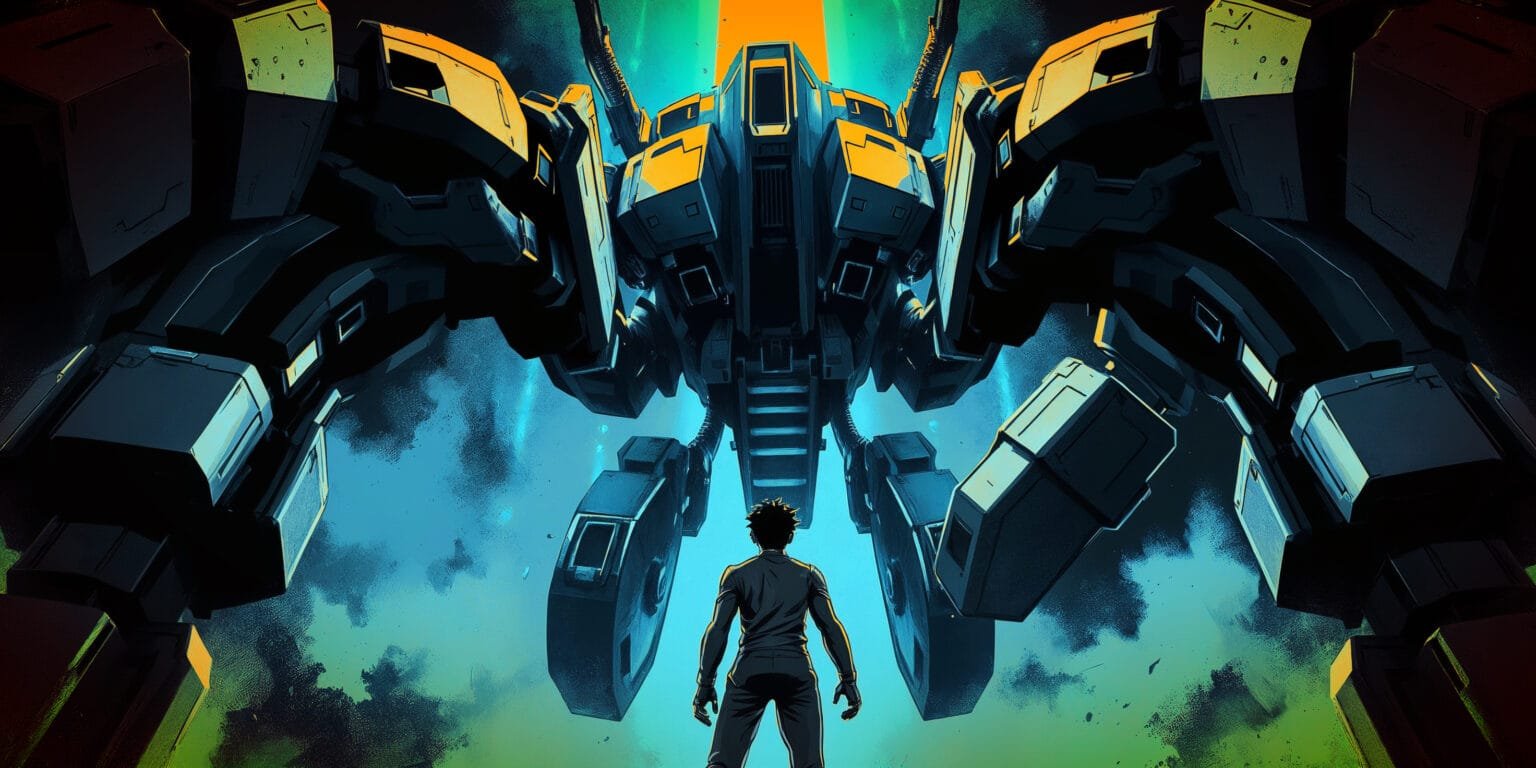
As you step closer—and a violent crash of metal against metal shatters the silence. You spin around as an enormous robot materializes, eight feet of gleaming metal and pulsing energy cores.
“Fight Mode Now Engaged” flashes across your vision as the machine charges with terrifying speed.
Its metal fist hooks horizontally and whistles past your face. You duck instinctively, your borrowed body’s muscle memory responding with trained precision. The robot’s fist clashing thunderously with the gate — connecting with enough force to rotate the entire room around nearly 180 degrees — every except the massive circular floor you and the robot stand. It seems to be the only surface truly grounded and stationary. The robot, now positioned as the only obstacle between yourself and the gate, pivots unnaturally fast, launching another strike that dents the metal floor where you stood a split-second before.
You sprint toward a support pillar closer to the gate, sliding beneath the robot’s next attack. Its massive fist embeds into the structure, buying you precious seconds but rotating the gate once again further away from you. The countdown ticks to “03:53” as you scramble toward the gate.
Your synesthetic perception transforms the deadly game into flowing patterns – blue attack vectors, golden defensive routes – a geometric dance as you evade rather than engage.
The robot miscalculates, crashing its fist into a wall. You seize the opening and dash toward the gate, heart pounding against your ribs. “The haptic feedback in this is insane,” you think, marveling at how your actual body seems to feel pain from your virtual avatar. “Must be using some kind of neural suggestion technology.”
You approach the sealed gate beyond — thankfully just a few meters out of the reach of the maniacal robot. You realize it is unable to leave the circular floor a few feet below you. As you stand in front, the ground just below where you stands illuminates in a subtle frosted electric blue. The gate’s interface surface ripples with digital encryption symbols that reorganize themselves constantly. The interface flickers back to life, displaying a challenge “ARE YOU HUMAN? PROVE YOU’RE NOT A ROBOT (OR HACKER)” — right above what you can now make out as three empty circled slots.
A security puzzle???
Most security systems just want a password. This one demands proof you’re human while actively trying to prove you’re not.
As you study the puzzle, your synesthetic perception reveals patterns hidden in the gate’s design. Colored threads of mathematical relationships form in your mind – golden spirals linking the slots together in a sequence that feels familiar yet just beyond your grasp.
You’ve never been good at captchas, and now one stands between you and whatever vital event waits beyond this security gate.
Just as you reach toward the interface, the floor beneath you splits open with a mechanical groan. Hydraulic pistons push steel panels apart, and you plummet through the gap, the countdown flashing “03:21” as digital static consumes your vision.
You crash onto a metallic landscape beneath twin artificial suns – massive spotlights mounted on mechanical arms that sweep across an ever-changing battlefield of shifting metal plates. The cold metal against your palms is laced with streams of ethereal code that flow like circuitry through the entire structure.
The ground itself consists of segmented plates that shift and reconfigure continuously, creating an ever-changing battlefield. Each plate is inscribed with digital runes that pulse with each transformation. Cooling vents periodically blast superheated steam into the air, the vapor itself containing fragments of data that shimmer before dissipating.
“03:15,” your internal timer warns.
All around you, hundreds of challengers – humans and droids alike – navigate the treacherous terrain. The “I’m Not a Robot” checkbox was annoying enough online. This version comes with actual robot sentries trying to kill you?!
Nearby, a woman in a red jumpsuit leaps over a suddenly appearing gap — but she moves with inhuman precision – an infiltration droid in perfect human disguise. A security drone emerges, its targeting beam bathing her in crimson light. One shot later, her body disintegrates into pixelated fragments. “HACKER BOT TERMINATED” hovers briefly where she stood.
The countdown blinks to “02:58” as cooling vents blast superheated steam into the air. Hurricane-force winds from industrial fans create unpredictable currents, visualized as swirling code patterns.
A section of the floor reconfigures, revealing a small metallic object. You sprint toward it as “02:37” flashes in your vision. Rotating saw blades extend from the walls without warning. You duck beneath one, feeling it slice through the air inches above your head while slicing several others around you into pixelated sparks.
Floor panels ahead electrify, crackling with blue energy. “02:20” blinks as you leap over them, landing unsteadily on a shifting platform. Your fingers close around the puzzle piece – a simple token with a single dot embedded in its center.
Instantly pneumatic pistons thrust upward, catapulting you back to the original security gate. The first slot pulses with anticipation. You hesitate, turning the piece over in your fingers. The countdown continues to ticks down… “Should I place this now or wait until I have all three pieces?” you wonder aloud. The gate offers no guidance, its digital interface pulsing patiently.
After a moment’s consideration, you place the dot piece into the first slot. It clicks into place, the interface acknowledging your choice with a pleasant chime. The slot locks, preventing any changes. “01:59” flashes now in red — without warning, mechanical claws erupt from the floor, clamping around your ankles and yanking you downward through another dimensional tear.
The cold hits like a physical blow. “01:47.”
Your lungs seize at the first breath of arctic air, the cold so intense it burns. Frost forms instantly on your eyelashes as you pull yourself onto a frigid platform floating in glowing cryogenic fluid. Your body shakes violently, each breath a painful struggle against the arctic air.
Enormous cooling units dominate the walls, their surfaces coated in thick layers of ice encasing flowing data streams. They blast arctic air across a landscape of more moving metal platforms floating in the sea of cryogenic fluid that glows with an eerie blue luminescence.
The temperature feedback is so convincing you almost forget it’s simulated. Whatever haptic technology this game engine is using, it’s incredible—you can practically feel the frost forming on your virtual skin. Even the breath effects as you exhale into the frigid air look photo-realistic, with tiny ice crystals catching the light.
You spot two metallic pieces hovering above a distant platform. “01:35.” With no time to waste, you leap between moving surfaces, the bitter cold making your movements sluggish. Mechanical arms emerge from below, rearranging the platforms in a complex, ever-shifting pattern.
Another challenger – a human – calculates its trajectory to a platform that suddenly retracts. It plummets into the cryogenic liquid, short-circuiting in a spectacular display. “01:28” blinks as you approach the two pieces, another piece with a single dot and the other with a line etched into its surface. You instinctively grab the second piece with line etching.
Before you can even celebrate this small victory, you’re instantly catapulted back to the gate. Your synesthetic perception suggests a simple progression – dot, then line. “01:22.” You slide the line piece into the second slot.
Electricity surges through your body as the interface flashes “INVALID SEQUENCE.” “CHALLENGE FAILURE – ONE LIFE LOST.” The countdown mercilessly continues: “01:15.”
You respawn in the chamber, the cold hitting you anew. This time, knowing the layout, you navigate the platforms more efficiently. You spot the other piece on a previously shifted platform – the one with the single dot in the center. “01:08” pulses red as you race across the shifting platforms and snatch it.
Back at the gate, you try the second dot piece instead. It slides into place with approval, triggering another mechanical transformation of your environment.
“00:59…”
Massive gears grind around you as you’re transported inside a colossal factory. The teeth of the gears rotating and interlocking with precision — the space appears to be the inside of a colossal machine. Conveyor belts transport robot parts beneath your feet, moving steadily toward an industrial shredder. “00:49.” Surrounding you all are rows of floating holographic puzzle pieces, each etched with more complex icons than the last.
A woman in a technician’s uniform sprints ahead of you toward what appears to be an objective. She notices a mechanical press descending from the ceiling and dives forward, barely avoiding being crushed as it slams down with earth-shaking force just inches behind her. The shock wave throws her against a nearby wall, but she recovers and continues her sprint.
You’re so focused on her narrow escape that you fail to notice another press directly above you. Without warning, it descends with crushing speed. The massive weight smashes into you before you can react, your body crumpling beneath its overwhelming force. Your vision fragments into pixels as a floating message appears: “CHALLENGE FAILURE – ONE LIFE LOST.”
The countdown shows “00:32” as you’re transported back to the conveyor belt and the rows of holographic puzzle pieces. At this point the conveyor has reached the halfway point to the shredder. Robotic arms reach from the walls as security sentries converge.
All around you, hundreds of challengers grab elaborate pieces – fractal patterns, tesseracts, complex symbols – only to disappear in flashes of failure. The competition is massive, a sea of desperate faces all trying different approaches, all overthinking the solution… “00:25.”
Anxiety builds in your chest as you scan the rows of pieces. The conveyor reaches unnervingly close to the shredder. “Which one is it?” you mutter, eyes darting between dozens of increasingly complex options. You scan the pieces frantically. The pattern started with one dot, then another dot… what comes next? A triangle? A three-dimensional shape? “00:21.”
The Archivist’s words strike like lightning: “Keep It Simple, Stupid.”
In a flash, you see it. Not complexity – simplicity. “00:15.”
You spot what everyone else is overlooking – a single piece with two dots side by side…
“00:09.” You lunge for it, ducking beneath a robotic arm. The moment you grab it, you’re back at the gate, sliding it into the final position: dot, dot, two dots… 1+1=2. The factory freezes. The gate unlocks with a series of pneumatic hisses.
Around you, the remaining challengers continue their futile efforts, trapped in a ghost-like endless loop of mechanical obstacles and security protocols. While hundreds fight for survival and overthink the puzzle, you alone found the simple truth hidden in plain sight.
You stand motionless, adrenaline still coursing through your veins. You can’t help but smile at the brilliant game design—creating a puzzle where overthinking is the real enemy. It’s the kind of elegant mechanical storytelling that the best games excel at, teaching you complex ideas through story, gameplay and simple, intuitive mechanics. Did the Archivist chose you for this very ability – seeing what others miss because they’re blinded by complexity?
“00:00” with a red “YOU’RE LATE” warning flashes accusingly across your vision.
Beyond the gate, an Ether Deck awaits on a raised platform, more advanced than any you’ve seen before. You rush forward, each second precious as you slide into the seat.
The Ether Rig descends automatically, interfacing with your neural pathways. The gravitational tug begins, pulling your consciousness through layers of reality. Your last coherent thought: simplicity might be your greatest strength in this bewildering new world.
The tether stabilizes as you emerge into a dimly lit space. Your UI displays “THE TEMPLE”. Your proxy body feels different—shorter, stockier than before.
The moment you fully materialize, a profound weightlessness washes over you. Your body feels buoyant, almost floating with each subtle shift of weight. You flex your fingers, marveling at how they cut through the air with virtually no resistance, as if moving through something thinner than atmosphere. The density of reality itself seems altered here.
You take a step forward and nearly stumble—your legs applying too much force for this environment. Each movement propels you further than expected, requiring a recalibration of your muscle memory. It’s like walking through water but without the resistance, your limbs drifting into position rather than driving there.
Your chest expands with a breath, and you’re startled by how effortless it feels. The air—if it even is air—floods your lungs with minimal exertion, oxygen-rich and somehow more substantial despite the lightness of everything else. Each breath delivers a clarity of thought that borders on euphoric, as if the very atmosphere enhances your cognitive processes.
Even your thoughts feel lighter, quicker, racing through neural pathways with enhanced speed. The cognitive weight you carried from the security challenge dissolves like morning mist, replaced by an almost supernatural alertness.
You think to yourself, “The transition between challenge environments was so seamless—no loading screens, no texture pop-in, just instant transportation between completely different worlds. Whatever processing power is driving this experience must be astronomical…”
That’s when you notice the updates in your heads-up-display:
“Prove Your Humanity: Complete”
“Into The Chamber: Unlocked”….
Another notification appears in your vision, “Fight Mode Disabled: Sacred Zone.”
“Where the @#!$&! have you been?!!!” a voice shouts through your comms. “The 6th One has already arrived at the Temple, and you’re supposed to be recording right now!”
“That’s your boss,” the Archivist’s voice suddenly returns to you internally. “Where were you?!” you think frantically. “That security challenge is a dead zone—one of the few places in THE ETHERVERSE I can’t reach.” “The Etherverse?!!” you screech, “THAT was the Etherve—?”
Your boss interrupts, “Get your @#%! to the Temple Chamber NOW before THEY enter—or we’re BOTH finished!”
“THEY? Who are ‘they’?” you ask hesitantly, trying to play along despite your confusion…
“Who do you THINK, you moron?” your boss roars through the comms, his voice distorted with fury.
“The @#!$&! AN’JELS…“

