
The body you’re about to wear belongs to someone important…
Someone with special privilege…
Somewhat with a dangerous occupation…
And you have no idea who they are…
This time, you’re aware of the tethering process—a gravitational tug in multiple directions, like being pulled simultaneously by invisible ropes. Your surroundings dissolve into particles of light, and for a moment, you float in absolute nothingness. An electric tingle spreads through your limbs as though your entire body is coming out of numbness — all happening in the matter of milliseconds.
Your vision zooms into focus with almost painful clarity, and suddenly you’re racing down an unfamiliar street in a body that isn’t yours. Your UI immediately augments the words “Los Demonios — The Surface” across your vision.
“Los Demonios?” you ask out loud.
Your comms instantly provides you with two artifacts entitled: The Surface and Los Demonios… You’ll definitely read them in depth when you get more time…
You glance down at yourself, surprised by the unfamiliar clothing. Your borrowed body is dressed in fitted synthetic pants that adjust their temperature with your movements, a long-sleeved shirt with embedded connectivity nodes that pulse with subtle blue light, and a jacket that seems to shift colors depending on the angle of light. On your wrist is a thin metallic band that occasionally projects small notifications into your peripheral vision.
The legs beneath you are longer than what you’re used to, the center of gravity higher. Your shoulders are broader, muscles more defined—you feel powerful, athletic. Each step covers more ground than seems possible. When you experimentally flex your hand, the movements are precise, controlled—like this body has been trained for optimized performance.
Los Demonios rises around you in a riot of sensation. The air carries a peculiar sweetness, like artificial fruit. Palm trees line the boulevards, but not like any you’ve seen before—their trunks wrapped in luminescent bio-mesh that pulses with soft blue light, fronds engineered to filter pollutants and shimmer with bioluminescence after dark. Occasional wafts of street food—spicy, savory, unfamiliar yet mouth-watering—drift from vendors whose carts hover inches above the sidewalk. The city itself seems alive with a constant background hum, punctuated by the occasional whoosh of passing autopods and the melodic chimes of personal devices.
Buildings soar upward at impossible angles, their glass and metal surfaces displaying shifting advertisements and news feeds. Light dances everywhere—from the clothing of passersby, from holographic displays that materialize and dissolve at eye level, from the very pavement itself, which glows softly to mark pedestrian pathways. The sky above is a curious shade of purplish-blue, dotted with personal transport drones that zip between skyscrapers like mechanical insects.
As you look around your eyes instantly lock on the mountain far off in the distance — the words “HOLLYWOOD” proudly standing…
“Wait, I’m still home?” you ask The Archivist.
“Yes, but no, you’re far in the future…” she responds internally.
“Wait — are there spaceships and interstellar travel in the future?” you ask eagerly, assuming this is all part of the game’s sci-fi setting.
“No, not as widespread as you ancients believe,” the Archivist responds with a hint of amusement. “Interstellar travel by ship is completely inefficient and counterproductive in reality. There is something better, but it’s yet to be realized even at THIS point in time. The KNOXX will reveal it to you in the future if you stay the course.”
A countdown timer suddenly appears in your field of vision, showing “13:37” and ticking down with alarming speed. Simultaneously, a waypoint marker appears, directing you through the city and pulsing with increasing urgency as the seconds slip away.
“You’re late,” the Archivist informs you. “And in this body’s line of work, being late has serious consequences.”
“What line of work?,” you asked…
“You’ll know soon enough,” she snaps back matter-of-factly…
Without fully understanding why, you feel a surge of genuine anxiety. You begin to run, your borrowed body responding with surprising speed and agility.
You dash across an intersection without checking the signal. An autopod swerves silently, missing you by inches—the heat of its engine block warming your skin as it passes. The driver’s furious face appears as a projection above the vehicle, shouting soundlessly behind the sealed windows.
The timer shows “12:48” remaining. Two blocks later, your foot catches a crack in the pavement. You stumble forward, crashing directly into a businessman walking the opposite direction. His coffee container explodes between you, splashing scalding liquid across his immaculate white suit. The synthetic fabric immediately begins to self-clean, the coffee beading up and rolling off, but the man’s face contorts with rage.
“Watch where you’re going, you worthless—” His tirade cuts off as you sprint forward. “Late for something? Better hurry,” he sneers, deliberately stepping aside with exaggerated slowness.
Your heart pounds as you check the waypoint again. The distance is shrinking—the pulsing marker showing you’ve covered nearly half the required ground. Your new body moves with impressive speed, legs eating up the pavement with each stride, barely winded despite the pace.
The waypoint pulses more urgently now, directing you toward what appears to be the center of a massive gathering. Ahead, the boulevard widens, but you can barely see the pavement for the sea of bodies filling it from building to building.
The countdown reads “11:32,” but your progress stalls as you encounter a massive protest blocking your path.
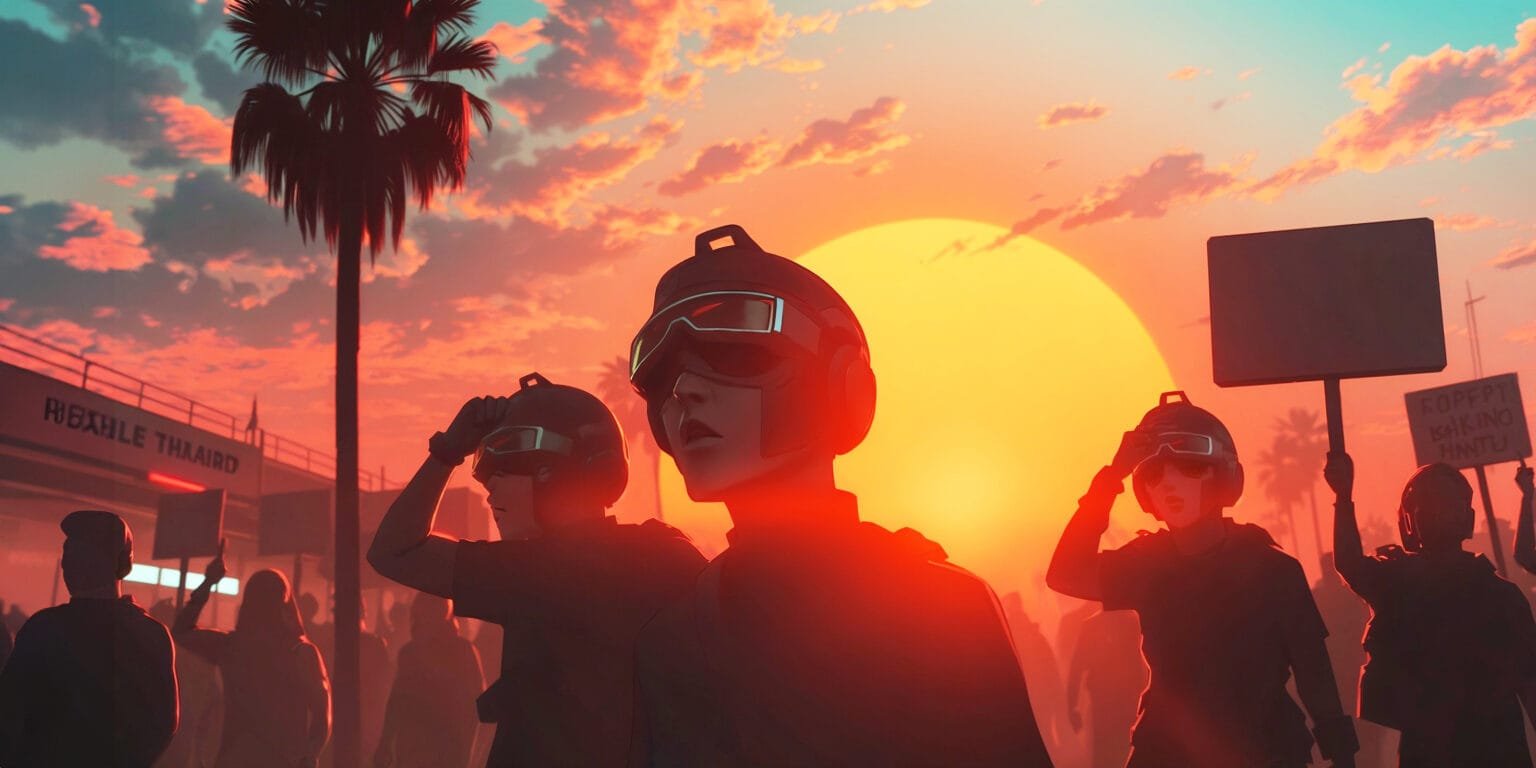
Police barricades create a perimeter around the demonstration, officers in sleek armored uniforms standing at attention. Their helmets feature transparent face shields displaying scrolling data, weapons at the ready—not lethal firearms, but devices emitting a soft blue glow that your UI labels as “NON LETHAL LAUNCHERS.”
They form barricades around two distinct groups. One side carries signs reading “THE FACELESS ONES AREN’T OUR ENEMIES” and “EMBRACE THE FUTURE.” Many wearing blue armbands with circuitry patterns. Opposing them, demonstrators in traditional clothing declare “HUMAN BODIES FOR HUMANS ONLY” and “H1: HUMANS FIRST.” Hovering media drones capture everything from above.
Among the H1 protesters, you notice several people holding large, visually striking signs. Each features a clean, minimalist design with three large, bold red 6s arranged in a row at the top: “6 6 6”. Below the numbers is a clear explanation:
“THE 6TH FACELESS ONE WAS PRINTED IN THE 6TH MONTH OF THE YEAR (JUNE) ON THE 6TH DAY OF THE WEEK (FRIDAY)”
At the bottom of each sign, in dramatic impact font: “COINCIDENCE? I THINK NOT!”
“Restricted area,” announces an officer as you approach, one hand moving to his weapon.
The Archivist whispers: “Check your pockets.”
Your fingers find a small card in your jacket—a press pass that identifies you as media, its surface shifting with micro-holographic security patterns that catch the light and display your credentials in pulsing neon script. The officer scans it, eyebrows raised.
“Media, huh? Fine. Pass through, but stay out of security zones.”
You slip past the barricade into the crowd—a human river flowing against your direction. Pushing forward, you’re immediately engulfed in a sensory assault: bodies pressed against you from all sides, competing chants creating a wall of sound, the smell of sweat and synthetic fabrics overwhelming your senses.
“NO MORE FACELESS ONES!” shouts one group rhythmically.
“THE 6TH ONE BRINGS DESTRUCTION!” counters another.
“Move!” you shout, but your voice is swallowed by the a disorienting wall of shouting, drumming, electronic amplification, and the constant whirring of media drones overhead. You activate your pattern recognition, analyzing the crowd’s movements. Finding a temporary flow, you slip through momentary gaps, gaining precious ground. The timer shows “10:45” remaining as you navigate through the mass of humanity, every step bringing you closer to your waypoint.
But then the pattern breaks unexpectedly. A surge in the crowd pushes you backward, undoing your hard-won progress. Your palms as you steady yourself against the ground. You dig in your heels and shove harder, earning angry glares and muttered curses. Someone’s hand pushes against your chest, deliberately blocking your path.
“Where do you think you’re going?” demands a large man with a “HUMANS FIRST” tattoo across his forehead. His breath smells of synthetic alcohol and cultivated mint. The bass vibration of his voice resonates in your chest from his proximity.
“Press,” you manage, gesturing to your wrist band. “Need to get through.”
“Press, huh?” He leans closer, his pupils contracting as they scan your features. The heat radiating from his skin feels like standing too close to an open furnace. “Which side are you on? The human side or the lovers of The Faceless Ones?”
“What are The Faceless Ones?” you ask, the term unfamiliar to your ears.
The Archivist’s voice whispers in your mind: “They’re mysterious entities that appear human but have no facial features. They’re at the center of this conflict.”
Before you can process this information, a woman with circuitry tattooed across her face intervenes, shoving herself between you and the man. The circuitry emits a faint electrical buzz that raises the hair on your arms.
“Back off, throwback,” she snarls, her modified eyes glowing faintly at the edges. “Media has passage rights.”
The man’s face darkens with anger, but the woman stands her ground, the circuitry in her face pulsing faster, emitting a heat you can feel from inches away. The air between them seems to crackle with tension. After a tense moment, he steps back, spitting on the ground near your feet before turning away. The bitter scent of his synthetic saliva cuts through the crowd’s overwhelming odor.
“Thanks,” you begin, but she’s already being swept along by the crowd, leaving only the lingering smell of ozone in her wake.
The countdown timer now reads “10:18,” with still half the human sea to navigate. You push forward with renewed determination, elbowing your way through the densest sections, squeezing through every gap that appears.
“STOP THE 6TH ONE!” roars a man through an amplification device, his voice so loud it makes your borrowed eardrums ache.
“THE ETHERVERSE IS OUR BIRTHRIGHT!” comes the response from the opposing side, equally deafening.
As you continue pushing through, you notice the tension in the crowd escalating rapidly. What started as angry chanting is transforming into physical confrontations. Two protesters shove each other violently, nearly knocking several others off their feet. A security officer rushes forward, non lethal launcher raised in warning.
Among the chaos, your eyes are drawn to a small group moving with coordinated purpose—men and women. Unlike the emotional protesters around them, their expressions remain coldly calculating. One catches you watching and holds your gaze with unsettling intensity, his pupils contracting as he studies you. Something in his gaze triggers your synesthesia—golden spirals fragmenting into blood-red fractals. The sensation is so jarring that you lose track of him in the crowd. A coincidence, you tell yourself, but your instincts scream otherwise.
A bottle arcs through the air, shattering against a police shield. Officers begin donning full face respirators, a clear sign they’re preparing for things to escalate. On the edges of the crowd, you see people falling back, recognizing the warning signs and retreating to safety.
In the center, however, the most dedicated protesters press closer together, their anger feeding off each other. Someone throws a punch. Another retaliates. Within seconds, a full brawl erupts between opposing factions.
As you navigate deeper past the center, you spot another man with “H1” emblazoned on his jacket pulling a wagon into the “Faceless Ones Supporters” section. Something about his furtive movements triggers your pattern recognition. He deliberately bumps into a counter protester, and within seconds, a fight erupts. In the ensuing chaos, the H1 supporter slips away, forgetting his wagon.
As you react to get his attention about his wagon, you accidentally trip over the wagon, knocking it onto its side. The contents spill out—metallic components, crystalline nodes, neural circuit boards, and at least 7 or 8 small cylindrical emitters roll across the pavement. Your UI comms instantly analyzes the scattered items, highlighting them with digital tags that flash red in your vision: “WARNING: NEURAL PROPULSION DISRUPTOR COMPONENTS…”
“Um — what is a neural propulsion disruptor?” you ask in your internal comms.
Your blood runs cold. “What’s a Neural Propulsion Disruptor?” you frantically ask the Archivist through your internal comms.
“In technical terms, it’s a device that generates an electromagnetic pulse specifically calibrated to disrupt the quantum entanglement fields that maintain tether connections between the hosts mind and the ghost patches installed inside proxy bodies,” the Archivist explains rapidly.
“But the simple version? It’s a proxy bomb.
“EVERYONE GET BACK!” you scream, but your voice is swallowed by the crowd’s roar. “EVERYONE GET BACK! PROXY BOMB!”
Your synesthetic pattern recognition kicks in automatically, calculating the signal radius and safe zones. Concentric circles overlay your vision, showing you exactly how far you need to get to avoid the tether-severing wave.
“Wow, it’s as if they’ve gamified my synesthesia perfectly,” you think, impressed curious if the designers have integrated your unique perception into the gameplay mechanics — or if it’s so immersive your mind can’t tell the difference. “It’s like they’ve turned my brain’s pattern recognition into an actual game mechanic.”
You shove through the crowd with renewed desperation, no longer concerned about politeness. It feels like the most immersive stealth mission you’ve ever played, with stakes that somehow feel real despite knowing it’s all virtual.
“PROXY BOMB! GET AWAY!” you continue to shout as you push toward the edge of the crowd. As the crowd thins, you grab the arms of those you pass. “RUN! THERE’S A PROXY BOMB!”
A few people finally heed your warning, their eyes widening in terror as they turn to flee.
Using your pattern recognition again, you spot a subtle path through the crowd where resistance is weakest. The waypoint shows 250 meters to go with “09:12” remaining as you weave through this temporary passage. But your success is short-lived—the pattern shifts unexpectedly, closing the gap you were navigating and forcing you into a denser section.
The timer reads “08:45” when you finally reach the thinning edge of the demonstration. Just as you prepare to break into a run again, the police response activates. Canisters arc through the air, their metal surfaces catching the sunlight before they land with dull thuds against the pavement. A split second later, they explode into clouds of tear gas with an angry hiss. The acrid chemical immediately stings your eyes and burns your nostrils, making your borrowed lungs spasm. Neural disruptors hum to life, their electric whine cutting through the shouting—a sound like angry mechanical wasps, officers advancing with stun sticks extended that crackle with blue energy.
A police voice booms through amplifiers mounted on hovering platforms: “THIS ASSEMBLY IS NOW UNLAWFUL. DISPERSE IMMEDIATELY OR FACE DETENTION.” The sound is so loud it vibrates your teeth and makes your eardrums ache.
Chaos erupts instantly. The crowd transforms from an organized demonstration into a panicked stampede. Bodies that had been pressing forward now surge backward, directly toward you. The ground literally trembles with the force of thousands of feet pounding in sudden retreat. Terror replaces anger on every face you can see. The smell of fear—sharp and sour—mingles with the tear gas and sweat.
You break free from the densest part of the crowd, lungs burning, legs pumping. The waypoint on your HUD feels impossibly distant now.
“RUN! EVERYBODY RUN!” you scream at the top of your lungs, waving your arms frantically at those still within the signal radius.
You notice something that sends a chill down your spine—those in proxies move with inhuman speed and precision, easily outrunning those in original human bodies. The disparity is shocking. The proxies zip through narrow gaps, vault over obstacles, and disappear into side streets, while those without augmentation struggle in the panicked press of bodies.
You dive behind a concrete planter, curling into a protective ball.
The Neural Propulsion Disruptor activates with a high-pitched whine that quickly rises beyond human hearing. A visible ripple of energy tears through the street—a transparent wave that distorts the air like heat rising from asphalt. The sound that follows isn’t an explosion but a bizarre anti-noise—a sudden vacuum of sound followed by the thunderous crash of hundreds of proxy bodies simultaneously collapsing to the ground like puppets with cut strings.
The shock wave hits you like a physical force—not heat and concussion, but a wall of pressure that ripples through your nervous system, making your borrowed proxy’s limbs spasm uncontrollably. Your vision pixelates momentarily, the tether connection flickering dangerously as the wave passes through you.
All around, proxies drop mid-stride, their vacant eyes staring sightlessly upward as their controlling consciousnesses are violently severed. Human bodies stumble in confusion, hands clutching at heads as the neural feedback causes momentary disorientation even in those not tethered to proxies.
“Move! MOVE!” someone screams, their voice cracking with panic as secondary disruptors activate, sending additional waves pulsing outward. Each new wave brings another ripple of collapsing bodies. The neural feedback hits you like a series of electric shocks, momentarily stealing your breath and making your ears ring. A high-pitched whine fills the air, the distinctive sound of thousands of tether connections being forcibly disrupted simultaneously.
Emergency drones wailing too close overhead, suddenly drop out of the sky, their red and blue lights casting eerie shadows across the chaos as they fall. Glass shatters from storefronts and buildings, the neural pulse’s resonant frequency causing crystalline structures to vibrate until they explode outward in glittering shards. Media cine-drones dart through the air, capturing the mayhem from every angle, their rotors adding to the overwhelming noise.
You turn and sprint, but the human wave moves faster. The air is thick with the acrid smell of ozone and something worse—the distinctive burnt-copper scent of neural processors overloading and the plastic tang of melting synthetic nerve pathways.
Your ears ring painfully as you stagger to your feet, disoriented and shaken. Emergency drones are already converging on the scene, their strobing lights cutting through the smoke. Police officers in heavy tactical gear push forward, establishing a perimeter. The first fleeing protesters crash into you, knocking you sideways. Your pattern recognition fails you completely—there is no pattern in pure panic. You stumble, foot catching on an uneven section of pavement, and go down hard. Pain explodes through your knee and palms as they slam against the ground. The rough concrete tears skin from your palms, embedding grit and small stones in the wounds.
Above you, the crowd becomes a blur of legs and feet. The thunderous noise of the stampede surrounds you, punctuated by screams and the continued wail of sirens. A boot comes down inches from your face, sending up a puff of dust that stings your eyes. Another strikes your shoulder, sending fresh pain radiating down your arm. You curl into yourself, feeling the vibrations of countless footfalls through the pavement beneath you, trying to protect your head as bodies rush past and over you.
Something metallic catches the light above the crowd—one of the miniature drones you saw spill from the wagon. It hovers momentarily, motors whining at a pitch almost too high to hear, before diving toward a police officer, exploding in a flash of light and a shower of sparks that shorts out the officer’s helmet displays.
More drones fill the air, targeting media equipment and security devices. The scent of burning electronics—acrid and unmistakable—fills your nostrils. Glass shatters as storefront windows implode with explosive force, the sound like a thousand crystal glasses breaking simultaneously. The sound of gunfire—actual ballistic weapons, not energy-based—cracks through the chaos, each report a physical assault on your eardrums.
Using every ounce of strength, you roll toward the edge of the stampede, the rough pavement scraping your skin through torn clothing. You finally find enough space to stagger to your feet, tasting blood from where you’ve bitten your lip in the fall.
The timer now reads “07:52,” and the waypoint still pulses urgently—only 150 meters to go, but with the chaos in full swing, it might as well be miles. Like the hardest escort mission you’ve ever played, only with graphics so realistic you keep forgetting it’s just a game…
But something doesn’t add up. This was supposed to be a game—the most advanced, immersive game ever created — at least that is what you believed. But games don’t leave you with the taste of blood in your mouth and the weight of hundreds of deaths on your conscience. And games certainly don’t make you question which reality is real…
The words “‘1+1’ Experience Unlocked” appear briefly in your vision…
With trembling legs, you continue toward your waypoint, the explosion’s aftermath burning itself into your memory. The countdown timer in your vision now shows “06:38” remaining, spurring you onward despite your shock. You run, ignoring the chaos behind you, focused solely on the destination. Each footfall sends jolts of pain through your bruised knee. Your breath comes in ragged gasps. But you’re moving again, making progress, the distance shrinking with every stride…

